Genocide.
It’s a big, loaded word — and an even heavier accusation to make against a nation-state.
Among these competing realities of recognition and denial, the Uyghur genocide remains one of the most politically obscured. It is emblematic of the Chinese government’s destruction of Uyghur continuity; an attempt to sever a people from their language, their faith, their culture, their history, and ultimately, their future.
There is overwhelming evidence of a coordinated campaign in East Turkestan — the homeland of the Uyghur people, referred to officially by the Chinese state as Xinjiang Uyghur Autonomous Region (XUAR). The Chinese Government has attempted to dismantle Uyghur identity through mass detention, family separation, forced labour, forced sterilisation, the suppression of religious practice, and the systematic erasure of Uyghur culture. It remains one of the most denied, dismissed, and politically inconvenient human rights crises of our era and meaningful political accountability has remained elusive.
Statistics alone cannot capture the reality of what is being lost. Genocide encompasses more than the destruction of human life en masse. It also involves the deliberate erasure of a collective identity, and the conditions necessary for a people to sustain themselves across generations.
At present, erasure remains a very real and present threat to the Uyghur community.
In Conversation with Subhi Bora
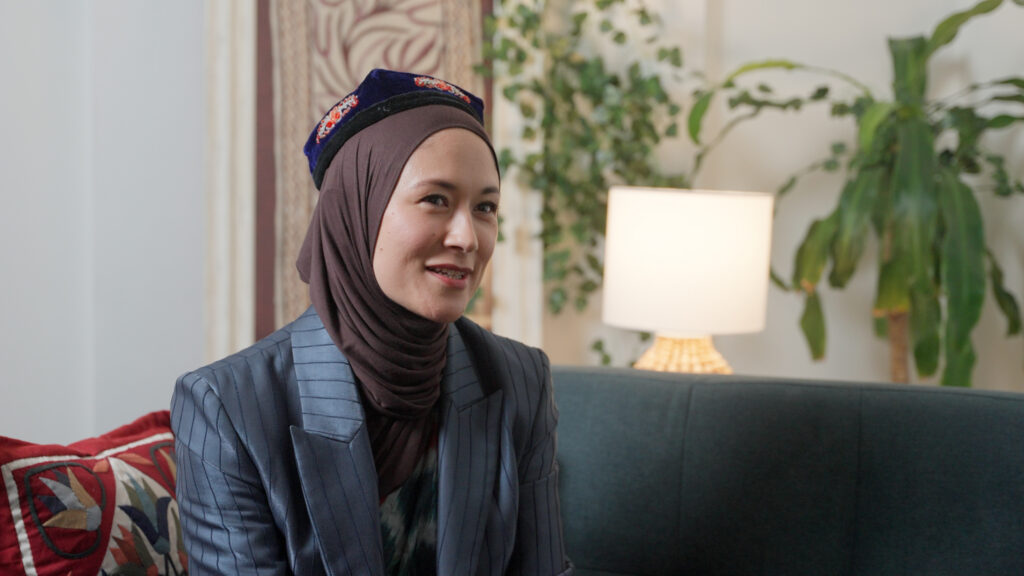
As part of Muslim Aid Australia’s Beyond the Headlines campaign, I sat down with Uyghur advocate, Subhi Bora. What emerged was a conversation about memory, identity, fear, and what it means to watch her people, including her own family, fight to preserve themselves against systematic erasure.
Subhi was born and raised in Australia, but her roots trace back to East Turkestan. Like many in the Uyghur diaspora, the catalyst to her political consciousness emerged through her family. As a teenager, her father sat her and her sister down and began speaking about the repression he had witnessed growing up, the trauma his family endured, and the reality facing Uyghurs under Chinese rule.
Years later, in 2014, Subhi travelled to East Turkestan to visit her grandmother and extended family. Long before the so-called “re-education” camps, referred to by Uyghurs as concentration camps, became internationally recognised, she encountered a society already living under an extraordinary and abnormal level of surveillance from every angle.
Drawing parallels to what we know about life for Palestinians under Israeli occupation, checkpoints across the East Turkestan region made occupation presence constantly known. Cameras monitored daily life, and Uyghur communities lived with the constant awareness that they were being watched. Privacy was a privilege not afforded to the Turkic ethnic minorities.
“At the time, I was like, this actually feels like an open-air prison,” she recalled.
During her visit, police officers arrived at her grandmother’s home and took her away for questioning. They wanted to know who she was, where she had come from, and what connections she maintained outside the country. Later, her passport was confiscated and she was interrogated again, but this time, they candidly asked her about her father – and made it known that they knew of his past.
The message was unmistakable as it was chilling: we know who you are, and we are watching.
Subhi spoke about relatives who disappeared into the camp system. One cousin, despite working for the Chinese government, was sentenced to twenty years in detention. His wife was also imprisoned for a few years, and came out of the camps a shadow of herself. The harrowing realisation here was that even compliance and loyalty within the system did not guarantee safety.
She also spoke about the gradual disappearance of language, culture, and memory. Younger generations of Uyghurs are increasingly disconnected from their mother tongue, particularly with the government actively policing any display of religious practices. Mosques have been demolished, repurposed, or placed under intense state control.
Subhi described how Chinese officials themselves have spoken, rather proudly, about the need to “break the lineage” and “break the roots” of the Uyghur people. To do this, their distinct identity must disappear from the history books, from online presence, and from future generations.
As Subhi put it,
“for Uyghurs, we don’t even get headlines.”
It is a simple statement, but one that captures the very purpose of Muslim Aid Australia’s Beyond the Headlines campaign.
For many around the world, and especially those cocooned in privilege, genocide belonged to history. It was something associated with the darkest chapters of the past: atrocities documented in textbooks, memorialised in museums, and universally condemned. Crimes whose victims were remembered, whose names were eventually etched into walls, and their clothes and shoes displayed as stark reminders of the depths of human cruelty.
Perpetrators were held accountable – but even accountability is not decided from the ground up purely on the basis of the evidence. If it were, we would be living in a vastly different world.
Instead, it is decided by those in power, for those without it.
The Myth of “Never Again”, and the First Condition of Survival
Before October 7, many still held onto the belief that these horrors were relics of another era. That humanity, having witnessed the consequences, would never allow them to happen again and would stop injustice in its tracks. After all, that was the very premise underpinning modern international law, its covenants and conventions, and the formation of the United Nations: that the world would learn from its failures and ensure such atrocities would never be repeated.
The issue with operating on such an assumption – when it is predicated on states more concerned with power, territory, colonial ambitions, and geopolitical interests than human life – is that it was always destined to fail. The institutions designed to prevent atrocities are only as effective as the political will behind them, and political will has never been distributed equally.
Right now, we are witnessing multiple, concurrent genocidal campaigns. Some are acknowledged and widely condemned, while others are denied, downplayed, or actively silenced, and often because doing otherwise would require confronting uncomfortable political and economic realities.
China’s economic influence has created a remarkable reluctance among governments, institutions, corporations, and even sections of civil society to confront what is happening. Subhi noted the impact of the government’s fear-mongering on those within the Uyghur community, who feel compelled to self-censor out of fear for themselves, and their loved ones.
The headlines have always been selective, and the media has long been the mouthpiece of power and politics. They tell us what is visible, which issues should matter, what is politically convenient to discuss, and which side of the world is the topical villain.
Justice cannot be contingent on media cycles, and solidarity should not be determined by algorithms.
If there is one lesson to draw from the Uyghur genocide, it is that long before a people disappear from the earth, they are often disappeared from public consciousness.
The challenge before us is to refuse the conditions that allow entire communities to be forgotten, or silenced.
For communities fighting against erasure, being remembered may be the first condition of survival.